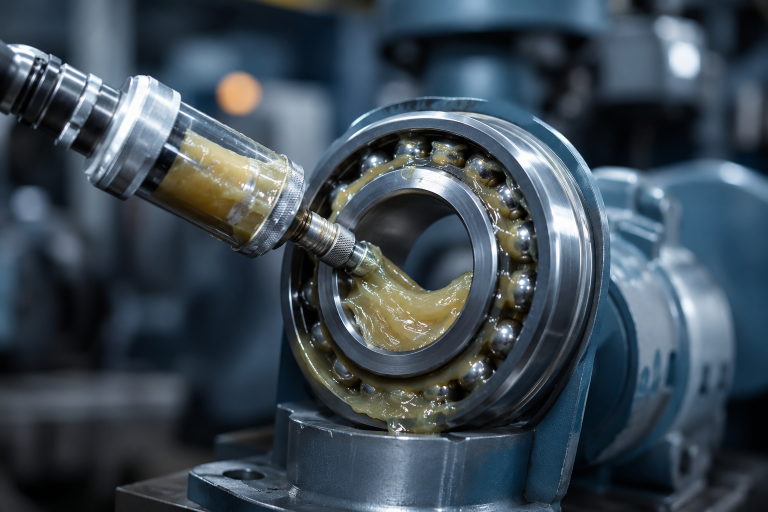

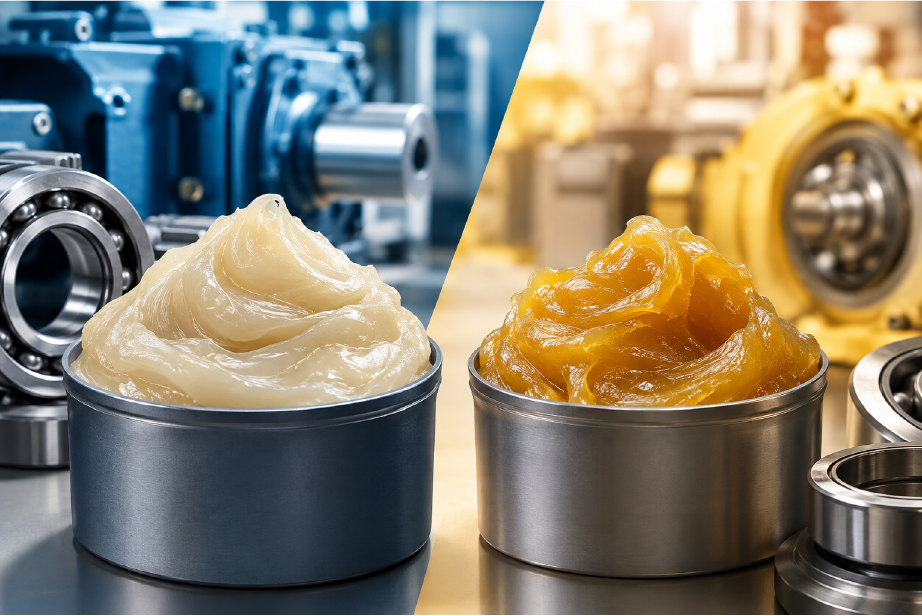
Choosing the right lubricant is one of the most important factors in extending equipment life and reducing maintenance costs across various industries. Among industrial greases, lithium grease and polyurea grease are extremely widely used, and are applied in many pieces of equipment for lubricating bearings, electric motors, industrial machinery, and other mechanical components.
Despite their outward similarity, these two types of grease differ significantly in thickener structure, high-temperature behavior, oxidation stability, water resistance, service life, and compatibility with other greases.
For this reason, it's impossible to say that one type of grease is always better than the other. The right choice should be based on the equipment type, operating temperature, rotational speed, load, environmental conditions, relubrication interval, and the equipment manufacturer's recommendation.
In this article, we provide a comprehensive comparison of lithium and polyurea grease so you can make a more precise choice for each application.
What Is Lithium Grease?
Lithium grease is one of the most widely used types of grease across various industries, made from a base oil combined with a lithium soap thickener. Because of its good balance between price, performance, mechanical stability, and reasonable water resistance, it's known as a general-purpose industrial grease.
Lithium greases are produced in various formulations and may use mineral or synthetic base oils, as well as different additive packages. For this reason, two different lithium greases don't necessarily perform identically.
One important advantage of lithium grease is its wide variety and easy availability in the market. It also delivers acceptable performance in many general-purpose applications, which is why it has been used across various industries for years.
What Is Polyurea Grease?
Polyurea grease uses a non-soap thickener based on polyurea. This chemical structure gives this type of grease very good performance in certain specific conditions, particularly at high temperatures and in long-term applications.
One well-known application of polyurea grease is lubricating electric motor bearings. This grease can offer good oxidation stability and can be a favorable option for equipment that requires longer relubrication intervals.
That said, it shouldn't be assumed that every polyurea grease is suitable for every motor or bearing. The product's technical specifications, base oil type, NLGI grade, equipment speed, operating temperature, and manufacturer recommendation should all be checked.
Comparing Lithium and Polyurea Grease by Structure
The most important difference between these two greases lies in their thickener type.
In lithium grease, the thickener is a lithium metallic soap, whereas polyurea grease uses a non-soap structure.
This structural difference is what causes differences in many performance characteristics.
Generally speaking, lithium grease is considered a general-purpose, economical option, while polyurea grease is more often favored in applications where thermal stability, oxidation resistance, and long service life matter more.
It's worth noting that "lithium grease" is not the same as "lithium complex grease." Lithium complex grease, due to its different structure, can offer higher temperature capability and performance than simple lithium grease. So in a technical comparison, it's important to specify exactly which type of lithium grease is being referred to.
Comparing Lithium and Polyurea Grease by Operating Temperature
Operating temperature is one of the most important criteria for selecting grease.
Standard lithium greases are generally suitable for general-purpose applications and conventional temperatures. As temperature increases, the stability of the grease structure and the base oil's resistance to oxidation become increasingly important.
Polyurea greases, in many formulations, perform well at higher temperatures and are therefore used in bearings with high operating temperatures or long relubrication intervals.
However, the maximum operating temperature shouldn't be decided solely by looking at a grease's dropping point. Dropping point is a laboratory test and is not necessarily equal to the permissible continuous operating temperature of the equipment.
As a result, selecting the right grease requires reviewing the actual operating temperature, rotational speed, load, bearing type, and the grease manufacturer's technical specifications.
Comparing Oxidation Resistance
Oxidation is one of the important factors in lubricant aging. When grease is exposed to high temperature and oxygen, its properties gradually change and its lubricating performance may decline.
Due to its thickener structure and formulation characteristics, polyurea grease offers high oxidation stability in many products. This is one of the reasons it's used in electric motors and bearings with long lubrication service life.
Lithium grease can also offer good oxidation stability, but its final performance depends on the base oil type and the product's additive package.
Therefore, if equipment operates at high temperature or the interval between relubrication stages is long, checking oxidation stability should be one of the main selection criteria.
Comparing Water Resistance
Water ingress into a bearing or other lubrication point can reduce lubricant quality, cause corrosion, and increase the likelihood of failure.
Standard lithium greases offer acceptable water resistance, but their exact performance depends on the product's formulation.
Polyurea grease can also perform well against water, but water resistance shouldn't be judged solely based on the thickener's name. Standard tests such as water wash-out resistance can provide more accurate information about a specific product's performance.
If equipment operates in a humid environment, outdoors, or in an environment with frequent washdown, grease selection should be based on the actual operating conditions and the product's technical data.
Comparing the Service Life of Lithium and Polyurea Grease
One important advantage often cited for polyurea grease is the potential for a long lubrication service life in suitable applications.
This is particularly important for electric motor bearings and equipment where access to the lubrication point is difficult.
However, grease service life doesn't depend solely on the thickener type. Base oil, viscosity, operating temperature, speed, load, contamination, grease quantity, and sealing conditions also play an important role.
So it can't be said that "polyurea always lasts several times longer than lithium." The comparison should be made based on two specific products and actual operating conditions.
Comparing Performance in Electric Motors
Electric motors are one of the important applications for polyurea grease. Many electric motor bearings are designed or filled with greases suited to high speed, operating temperature, and long lubrication life.
Polyurea is a common choice in many of these applications due to its oxidation stability and good performance under thermal conditions.
In contrast, using a general-purpose lithium grease in an electric motor without checking the manufacturer's recommendation may not be a good decision.
In this area, the most important principle is that the grease used must match the motor and bearing manufacturer's recommendation.
Comparing Mechanical Stability
Grease must retain its structure to a reasonable degree under operation, vibration, and mechanical stress.
Excessive softening of the grease's consistency can cause the lubricant to escape from the intended location, while excessive hardening can make the grease difficult to move and increase internal resistance.
Both lithium and polyurea grease can offer good mechanical stability when properly formulated. So for an accurate selection, the test results for the specific product in question should be reviewed.
The Most Important Difference: Compatibility with Other Greases
One of the most sensitive topics in comparing lithium and polyurea grease is compatibility.
It shouldn't be assumed that because both products, for example, have an NLGI grade of 2, they can be mixed together.
The NLGI grade only indicates the grease's consistency and, on its own, doesn't determine whether two greases are compatible.
Mixing a polyurea grease with a lithium grease can cause changes in consistency, oil separation, softening or hardening of the mixture, and reduced lubrication performance.
For this reason, when changing grease type, the compatibility of the two products should be checked based on technical information or compatibility testing.
For sensitive equipment, the more reliable approach is usually to drain or clean out the previous grease and completely replace it with the new one.
Can Lithium and Polyurea Grease Be Mixed?
Generally, lithium and polyurea grease should not be mixed without confirming compatibility.
Even if two greases look similar, their thickener structures may not be compatible with each other.
If you intend to change grease type, it's best to first review the technical information for both products. For sensitive equipment, cleaning out the previous grease before using the new one reduces the risk of incompatibility.
This is especially important for electric motors, high-speed bearings, and expensive equipment.
Lithium vs. Polyurea Grease Comparison Table
| Feature | Lithium Grease | Polyurea Grease |
|---|---|---|
| Thickener type | Lithium soap | Polyurea, non-soap |
| General-purpose use | Very suitable | More for specialized applications |
| Thermal stability | Good, depending on formulation | Usually very good |
| Oxidation stability | Good to very good | Usually very good |
| Use in electric motors | Depends on manufacturer recommendation | Very common |
| Lubrication service life | Suitable | Can be long in suitable applications |
| Availability and variety | Very high | Lower than lithium |
| Cost | Usually more economical | Usually higher |
| Compatibility with other greases | Depends on grease type | Requires careful checking |
| Choice for general-purpose equipment | Suitable option | May be more than needed |
Is Lithium Grease Better, or Polyurea?
The answer to this question depends on the application's conditions.
If your goal is general-purpose lubrication, reasonable cost, easy availability, and use in standard machinery, lithium grease can be a suitable choice.
If the equipment operates at a higher temperature, has a long relubrication interval, or the electric motor bearing requires a specialized grease, polyurea may be the more suitable option.
However, under no circumstances should the decision be based solely on the grease's name.
Parameters such as the following should be reviewed:
- Bearing type
- Rotational speed
- Operating temperature
- Applied load
- Base oil type
- NLGI grade
- Environmental conditions
- Moisture level
- Relubrication interval
- Equipment manufacturer's recommendation
- Compatibility with the previous grease
What Factors Matter in Choosing the Right Grease?
Grease selection doesn't end with just a lithium-vs-polyurea comparison. In some conditions, lithium complex, calcium sulfonate complex, or other types of lubricant may perform better.
For the right selection, the operating conditions must first be clearly defined.
Equipment Speed
High-speed bearings generally need a grease that behaves well under rising temperatures and shear forces.
Operating Temperature
The equipment's actual operating temperature must fall within the grease's recommended range.
Load
For heavy loads, the grease's anti-wear properties and pressure tolerance become more important.
Operating Environment
Water, dust, chemicals, and industrial contamination can change which grease is appropriate.
Relubrication Interval
If access to the equipment is difficult, choosing a grease with a suitable service life becomes more important.
Common Mistakes When Choosing Between Lithium and Polyurea Grease
One common mistake is choosing grease based on price alone. Cheaper grease doesn't necessarily result in lower overall cost, since bearing failure or a production line stoppage can create far greater costs.
Another mistake is ignoring the equipment manufacturer's recommendation. If the motor or bearing manufacturer has recommended a specific type of grease, replacing it should only be done after technical review.
Also, applying new grease over old grease without checking compatibility can cause problems.
Another common error is over-greasing. Adding more grease doesn't always mean better lubrication, and in some bearings it can increase temperature and internal resistance.
How to Choose the Right Grease?
For a professional grease selection, you can follow this process:
Step 1: Review the equipment and bearing specifications.
Step 2: Determine the actual operating temperature and rotational speed.
Step 3: Review the load and environmental conditions.
Step 4: Study the equipment manufacturer's recommendation.
Step 5: Review the grease's technical specifications, including base oil, thickener, NLGI grade, and additives.
Step 6: Check the compatibility of the new grease with the previous one.
Step 7: Determine an appropriate plan for grease quantity and relubrication interval.
Frequently Asked Questions About Comparing Lithium and Polyurea Grease
Is polyurea grease better than lithium grease?
No. Polyurea offers important advantages in certain applications, such as electric motors and specific thermal conditions, but lithium grease is also an economical and suitable choice for many general-purpose applications.
Is polyurea grease suitable for bearings?
Yes, many polyurea greases are designed for lubricating bearings, especially in electric motors and applications where long lubrication service life matters. However, the product's specifications and the bearing manufacturer's recommendation should be reviewed.
Can polyurea grease be mixed with lithium grease?
This shouldn't be done without checking compatibility. The thickener type, base oil, and additives of both greases should be reviewed, and for sensitive equipment, cleaning out the previous grease is the safer option.
What applications is lithium grease suitable for?
Lithium grease is used in many general industrial applications, bearings, and mechanical machinery, and is one of the most common types of industrial grease due to its good availability and competitive price.
For an electric motor, is lithium or polyurea grease better?
In many electric motors, polyurea grease is a common choice; but the final decision should be based on the motor and bearing specifications and the manufacturer's recommendation.
Does both greases having an NLGI grade of 2 mean they're compatible?
No. NLGI 2 only indicates the grease's consistency and doesn't mean the two products are compatible. The thickener type, base oil, and additive package should also be reviewed.
Conclusion: Lithium or Polyurea?
In comparing lithium and polyurea grease, there's no single absolute winner. Both types of grease are designed for specific applications, and the right choice depends on the equipment's actual operating conditions.
Lithium grease, due to its reasonable price, wide variety, and balanced performance, is a common choice for many general-purpose applications. Polyurea grease, on the other hand, is considered a more specialized option due to its good oxidation stability and favorable performance in many thermal applications and electric motor bearings.
If the equipment is sensitive, expensive, or operates under difficult conditions, grease selection should be based on technical information and actual operating conditions, and should never be decided based solely on price or product name.
Ultimately, the best grease isn't the one with the highest specifications on paper — it's the one that best matches the equipment type, operating conditions, and the manufacturer's requirements.