

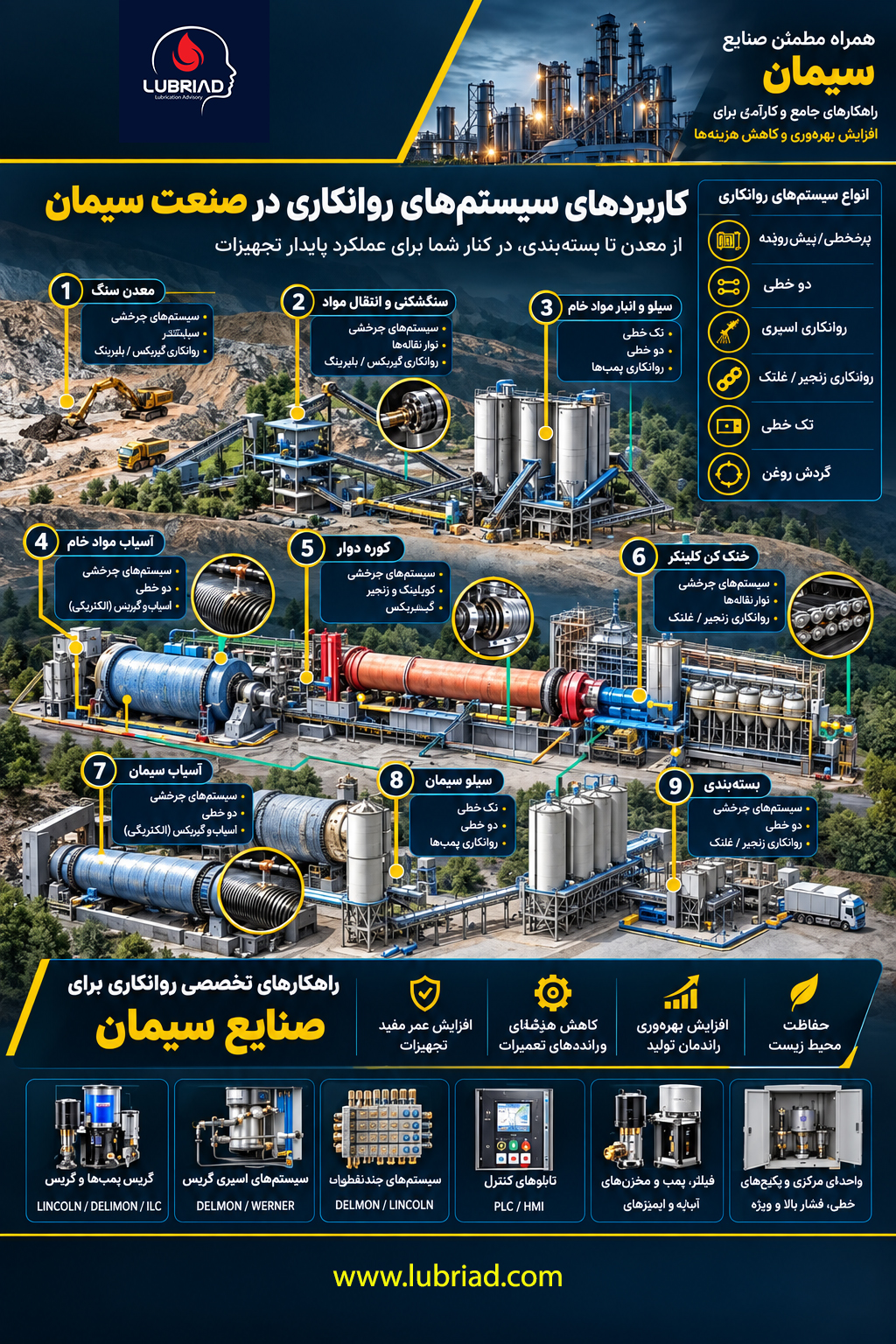
What Is Cement Industry Oil?
Cement industry oil refers to a range of industrial oils, greases, and lubricants designed to lubricate and protect the equipment used in cement plants.
The cement production process creates extremely harsh conditions for equipment. High temperatures, heavy loads, shock and vibration, dust, moisture, and continuous operation are among the factors that can increase component wear and reduce machinery life.
For this reason, choosing the right oil and lubricant in a cement plant isn't just a maintenance matter — it's part of a preventive maintenance program and a way to increase equipment reliability. Specialized lubrication industry sources also emphasize the importance of choosing the right lubricant for gearboxes, open gears, bearings, and hydraulic equipment in cement plants.
Why Choosing the Right Oil Matters in the Cement Industry
Cement plants typically operate continuously and under heavy load. A sudden stoppage of equipment such as a rotary kiln or mill can create significant costs for the company.
The right oil can help with the following:
- Reducing friction between components
- Reducing gear and bearing wear
- Controlling heat generated in equipment
- Protecting against corrosion and rust
- Extending oil and component life
- Reducing the frequency of repairs
- Reducing the likelihood of emergency production line stoppages
- Improving equipment efficiency
- Reducing maintenance costs
In the cement industry, lubrication is especially important due to the presence of dust and heavy mechanical loads. Much of the equipment also operates at high temperatures or under shock and vibration conditions.
Types of Cement Industry Oil
Given the wide variety of equipment, a single oil can't be used for all machinery in a cement plant. Each piece of equipment requires a specific lubricant based on its design, temperature, speed, load, lubrication system, and manufacturer recommendation.
The most important types of cement industry oil include:
- Industrial gear oil
- Open gear oil
- Hydraulic oil
- Compressor oil
- Circulating oil
- Turbine oil
- Bearing-specific oils
- Industrial and EP greases
- Specialized synthetic and semi-synthetic oils
1. Industrial Gear Oil in Cement Plants
One of the most important types of cement industry oil is industrial gear oil.
The gearboxes used in mills, kilns, crushers, conveyors, and other power transmission equipment operate under high loads. Under such conditions, the oil must be able to form a proper lubricating film and protect against wear.
Industrial gear oils are typically selected based on specifications such as viscosity, additive type, load-carrying capacity, and gearbox design.
For example, specialized lubricant manufacturers for cement plants offer mineral and synthetic gear oils for various gearboxes.
The Most Important Properties of Gear Oil Suitable for Cement Plants
- Good pressure resistance
- Anti-wear properties
- Thermal and oxidation stability
- Corrosion protection capability
- Compatibility with seals and gearbox components
- Viscosity suited to the operating temperature
- Long-term performance capability
2. Open Gear Oil and Lubricant
Open gears are one of the most important lubrication points in a cement plant.
This type of gear is typically found in the drive systems of rotary kilns and mills, and unlike gears inside a gearbox, they are not enclosed in a fully sealed housing.
For this reason, the lubricant must have adequate adhesion so it doesn't separate from the tooth surface as the gear rotates.
In specialized cement lubrication sources, dedicated open gear lubricants for kilns and mills are introduced as an important application. Some of these products have high viscosity and EP and anti-wear additives.
Properties of Open Gear Lubricant
A suitable lubricant for this application must be able to:
- Remain on the tooth surface;
- Withstand high pressure;
- Prevent wear and corrosion;
- Remain stable at high temperatures;
- Perform well under shock and intermittent loads.
For further reading, refer to: www.prgklub.com
3. Cement Industry Hydraulic Oil
Hydraulic systems are used in various sections of a cement plant. These applications include mill equipment, transfer systems, roller presses, and some auxiliary equipment.
Cement industry hydraulic oil must offer good resistance to oxidation, wear, heat, and contamination.
Anti-wear hydraulic oils are used in many industrial cement systems, and the right grade should be selected based on the hydraulic system manufacturer's specifications.
Benefits of the Right Hydraulic Oil
- Reduced pump and valve wear
- Protection of components against corrosion
- Stable performance at operating temperature
- Helps extend equipment life
- Better control of contamination and deposits
4. Compressor Oil in the Cement Industry
Compressors are also important equipment in many cement plants and require their own specific oil.
Compressor oil should be selected based on the compressor type, operating temperature, pressure, and manufacturer recommendation.
Using an unsuitable oil can increase deposit formation, oxidation, temperature, and reduce compressor component life.
For this reason, compressor oils should be defined and controlled separately within the plant's lubrication program.
5. Industrial Grease in Cement Plants
Although the term "cement industry oil" mostly refers to industrial oils, grease is also an important part of a cement plant's lubrication system.
Grease is used in many bearings, electric motors, conveyors, fans, and some moving joints and mechanisms.
EP greases are a common choice for applications with higher load and pressure. Some lubricant manufacturers also offer specialized greases for bearings, gears, and high-temperature equipment for the cement industry.
What Is the Right Oil for a Cement Kiln?
The rotary kiln is one of the most sensitive pieces of equipment in a cement plant, and its various sections require different lubrication.
For example, the kiln's drive system may include a gearbox and open gear. The kiln's bearings and auxiliary equipment also require the right lubricant.
Therefore, a single product can't be introduced as the "best cement kiln oil."
Oil selection should be based on the following:
- Equipment type
- Lubrication system type
- Operating temperature
- Rotational speed
- Load level
- Gear or bearing type
- Equipment manufacturer's recommendation
- The plant's environmental conditions
For the kiln's open gear, products with high adhesion and load-bearing capability are usually of great importance.
The Right Oil for a Cement Mill
The mill is another critical piece of equipment in a cement plant.
Ball mills, vertical roller mills, and other material grinding equipment have various power transmission systems and bearings.
For this reason, cement mill oil selection should be done separately for each lubrication point.
In mills, you'll typically encounter the following:
- Gearbox oil
- Open gear lubricant
- Hydraulic oil
- Bearing grease
- Circulating oil
Some specialized lubricant manufacturers have introduced gear oils, greases, and open gear lubricants for various types of cement mills.
The Most Important Criteria for Selecting Cement Industry Oil
Selecting a lubricant based solely on product name or price isn't the right approach. Choosing cement industry oil requires reviewing a range of technical parameters.
Oil Viscosity
Viscosity is one of the most important specifications of an industrial oil.
If viscosity is too low, the oil film thickness may not be sufficient to protect surfaces. On the other hand, excessively high viscosity can increase resistance to movement and raise operating temperature.
Therefore, viscosity grade selection should be based on the equipment design and manufacturer's guidelines.
Heat Resistance
Cement industry equipment operates at high heat in many locations. The oil must offer good stability within the intended temperature range.
Anti-Wear Properties
The presence of heavy loads and high pressure makes anti-wear properties highly important in many cement lubricants.
Oxidation Resistance
Oil oxidation can cause quality degradation, deposit formation, and reduced lubricant life. Oils with good oxidation stability can be useful for extending oil change intervals; however, this should be controlled through oil condition monitoring and OEM recommendations.
Water and Contamination Resistance
The presence of dust and the possibility of moisture ingress are major challenges for cement plants. Therefore, contamination control and selecting a lubricant suited to environmental conditions are highly important.
The Difference Between Mineral and Synthetic Oil in the Cement Industry
Both mineral and synthetic oils are used in cement industry equipment.
Mineral Oil
Potential advantages:
- Usually lower initial cost
- Good availability
- Wide use in industrial equipment
Synthetic Oil
Potential advantages:
- Good thermal and oxidation stability in certain formulations
- Potential for better performance in some difficult conditions
- Potential for extended oil life in suitable applications
- Reduced friction and energy consumption in some systems
However, an oil being synthetic alone doesn't mean it's more suitable for every piece of equipment. Selection should be based on the equipment's technical manual, oil specifications, and actual operating conditions.
Cement Industry Oil Application Table
| Equipment | Common Lubricant Type | Main Purpose |
|---|---|---|
| Kiln gearbox | Industrial gear oil | Reducing wear and withstanding load |
| Kiln open gear | Dedicated open gear lubricant | Protection against pressure and wear |
| Mill | Gear oil, hydraulic oil, or dedicated lubricant | Protecting the power transmission system |
| Crusher | Gear oil and grease | Withstanding load and shock |
| Hydraulic system | Hydraulic oil | Anti-wear protection and power transmission |
| Bearings | Suitable grease or oil | Reducing friction and wear |
| Compressor | Compressor oil | Reducing wear and controlling deposits |
| Fans | Suitable oil or grease | Bearing lubrication |
| Conveyor | Gear oil and grease | Protecting the power transmission system |
Common Mistakes in Selecting Cement Industry Oil
Using One Oil for All Equipment
Each piece of equipment has different operating conditions. Using a general-purpose oil for all equipment can reduce performance and increase the risk of failure.
Ignoring Viscosity
Even if the oil is suitable in terms of brand and quality, choosing the wrong viscosity grade can affect system performance.
Mixing Incompatible Oils
Combining different oils without checking their compatibility can change the lubricant's properties.
Ignoring Oil Contamination
Dust, water, and metal particles can reduce the life of the oil and the equipment. Therefore, filtration, sampling, and contamination control are an important part of the lubrication program.
Changing Oil Based Solely on Time
The oil change interval should be determined based on the equipment type, operating conditions, manufacturer recommendation, and, where possible, oil analysis results.
How to Choose the Best Cement Industry Oil
To choose the best cement industry oil, it's best to follow a clear process:
Step 1: Identify the Equipment
First, determine which equipment the oil will be used for — for example, a gearbox, kiln, mill, hydraulic system, or compressor.
Step 2: Review the Manufacturer's Manual
The oil specifications recommended by the equipment manufacturer should be given priority.
Step 3: Assess Operating Conditions
Temperature, load, speed, pressure, dust levels, moisture, and how the equipment operates should be reviewed.
Step 4: Choose the Right Grade
After reviewing the above information, the required viscosity grade and standards are determined.
Step 5: Monitor Oil Performance
After use, oil condition should be checked at appropriate intervals. For sensitive equipment, oil analysis can provide valuable information about the condition of the lubricant and the equipment.
Benefits of Using the Right Oil in the Cement Industry
Choosing the right lubricant can be part of a comprehensive maintenance and reliability program and can help with the following:
- Extending component life
- Reducing sudden failures
- Reducing repair costs
- Reducing lubricant consumption
- Increasing equipment reliability
- Reducing production line downtime
- Better protection of gearboxes and bearings
- Improving energy efficiency in some applications
Specialized lubricant brands for the cement industry also emphasize reduced wear, extended equipment life, and reduced risk of production stoppages as the main benefits of choosing the right lubricant.
Conclusion
Cement industry oil is one of the important elements in maintaining and increasing the reliability of cement plant equipment. From the kiln's gearbox and open gear to mills, hydraulic systems, compressors, and bearings, every section requires a lubricant suited to its operating conditions.
The most important point is not to focus solely on price or brand name when purchasing industrial oil. The equipment's technical specifications, viscosity, operating temperature, load level, lubrication system type, and manufacturer recommendation should all be considered in the selection process.
Ultimately, a proper lubrication program that includes the right oil selection, proper maintenance, contamination control, and oil condition monitoring can play an important role in reducing failures and maintenance costs at a cement plant.
Frequently Asked Questions About Cement Industry Oil
What is the best cement industry oil?
A single oil can't be introduced as the best option for all equipment in a cement plant. Oil selection depends on the equipment type, operating conditions, and the specifications stated by the manufacturer.
What properties should cement kiln gearbox oil have?
Kiln gearbox oil should be selected to match the gearbox design, load, temperature, speed, and lubrication system, and properties such as anti-wear performance, thermal stability, and load-bearing capacity are usually important.
Is synthetic oil better for a cement plant?
Synthetic oil can offer good advantages in some high-temperature or heavy-load applications, but an oil being synthetic alone doesn't mean it's suitable for all equipment.
What is hydraulic oil used for in the cement industry?
Hydraulic oil is used for various hydraulic systems in the plant, including some mill and press equipment and other machinery, and should be selected based on the system's specifications.
Can different oils be mixed together?
It's not recommended to mix different oils without checking their compatibility. If changing the oil type, it's best to review the manufacturer's guidelines and the technical information of both products.
How often should the oil in cement plant equipment be changed?
There's no single fixed interval for all equipment. Operating conditions, oil type, manufacturer recommendation, and oil monitoring or analysis results can all influence determining the right time for a change.