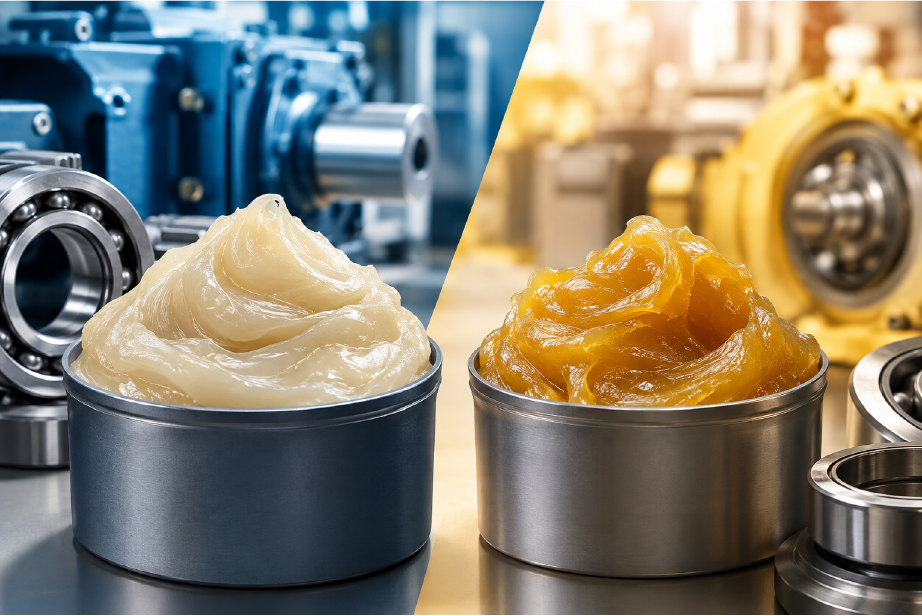

Many industries and organizations, when choosing a lubricant, put all their focus on finding the best grease. Grease type, brand, NLGI grade, temperature range, pressure resistance, and other technical specifications are reviewed in order to select a product suitable for the equipment.
But can choosing the best grease alone guarantee optimal equipment performance?
The answer is no.
Even the best and most expensive grease, if used in the wrong amount, at the wrong time, or with the wrong method, cannot properly protect the equipment. In fact, choosing the grease is only half the path to success in lubrication, and the other half relates to how it is used, the greasing method, the amount of grease, and the lubrication management strategy.
For this reason, organizations seeking to extend equipment life, reduce maintenance costs, and prevent sudden failures must shift their focus from "buying grease" toward professional lubrication management.
The best grease is not enough without proper lubrication
Grease is meant to reduce friction and wear by forming a lubricating film between moving surfaces, and to protect components from factors such as pressure, heat, moisture, and contamination.
However, grease performance depends on various factors, including:
- Grease type
- Amount of grease used
- Greasing intervals
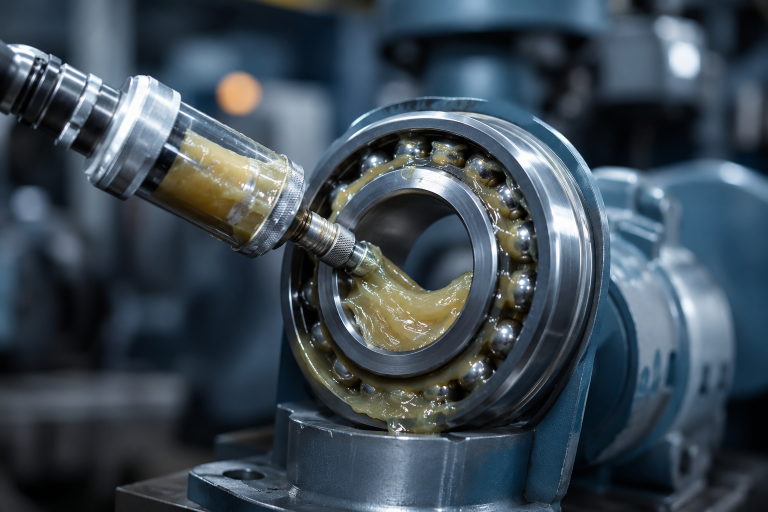
- Grease application method
- Equipment operating conditions
- Operating temperature
- Rotational speed
- Load level
- Environmental conditions
- Contamination present in the environment
- Equipment sealing condition
Therefore, a grease may be perfectly suitable for a bearing in terms of technical specifications, but improper use of that same grease can cause increased temperature, leakage, wear, or even bearing failure.
Suitable grease delivers the most performance when it is used within a correct lubrication strategy.
What problems does over-greasing cause?
One common mistake in equipment maintenance is the assumption that "the more grease, the better the lubrication."
Whereas over-greasing can be just as problematic as under-greasing.
When a large amount of grease enters a bearing, the internal space may become filled with more grease than is required. In rotating equipment, this can increase resistance to movement and generate excessive heat.
Possible consequences of over-greasing include:
- Increased bearing temperature
- Increased resistance to movement
- Increased grease consumption
- Grease escaping through seals
- Contamination of the area around the equipment
- Reduced grease life
- Increased maintenance costs
Therefore, the amount of grease should be determined based on the bearing type, dimensions, speed, operating conditions, and manufacturer recommendation.
More grease does not necessarily mean better lubrication.
Under-greasing: when the lubricant is not enough
On the other side, insufficient grease can also severely affect equipment performance.
If the amount of grease present at the lubrication point is not enough to form and maintain a lubricating film, metal-to-metal contact increases. The result of this can be increased friction and wear.
Some consequences of insufficient greasing include:
- Increased friction
- Increased wear of components
- Increased operating temperature
- Noise and vibration
- Reduced bearing life
- Increased likelihood of sudden failure
- Increased repair costs
For this reason, determining the right amount of grease and the right interval for re-greasing is one of the important parts of an equipment maintenance and lubrication program.
Grease leakage: a sign that should not be ignored
Grease leakage around a bearing or lubrication point can have various causes.
Excessive grease use, choosing an unsuitable grease, high temperature, pressure, sealing conditions, or even mechanical problems in the equipment can all play a role in causing this issue.
In addition to wasting lubricant, grease leakage can cause contamination in the work environment and increase lubricant consumption costs.
On the other hand, observing a leak should not simply be treated as "grease being consumed"; in some cases it can be a sign of an underlying technical problem in the equipment that needs to be investigated.
How does incorrect greasing cause premature bearing wear?
Bearings are among the most important components of many industrial equipment, and their failure can cause production line stoppages and impose significant costs.
One of the factors affecting bearing life is its lubrication condition.
If the right grease has not been selected, or if the amount and timing of greasing are not correct, the bearing's operating conditions move away from the desired state.
For example:
Insufficient grease → increased friction → increased temperature → increased wear → reduced bearing life
On the other hand:
Excessive grease → increased movement resistance → increased temperature → faster grease degradation → reduced lubrication performance
Therefore, the goal of lubrication is not merely "the presence of grease"; rather, favorable lubrication conditions must be maintained throughout the equipment's life.
The cost of incorrect greasing is not just the cost of buying grease
When discussing the cost of lubrication, we shouldn't consider only the price per kilogram of grease.
The real cost of improper lubrication can include the following:
- Excessive grease consumption
- Frequent lubricant purchases
- Increased frequency of repairs
- Premature bearing replacement
- Production line stoppages
- Labor costs
- Spare parts costs
- Emergency repair costs
- Reduced equipment productivity
For this reason, reducing grease consumption alone is not the ultimate goal. The main goal should be optimizing lubricant consumption alongside increasing equipment reliability.
Sometimes a professional lubrication program can reduce overall maintenance costs by cutting unnecessary grease consumption and preventing equipment failure.
Why should we move from "greaser" to "lubrication technician"?
One of the most important points to consider in industrial lubrication management is the role of human resources.
Greasing should not be treated merely as a simple, repetitive task that anyone can perform without specialized training.
The person responsible for equipment lubrication must, in addition to being familiar with greasing tools, also have sufficient knowledge of the basic principles of lubrication.
A lubrication technician or specialist must be able to understand things such as:
- Which grease is suitable for the equipment?
- What is the appropriate amount of grease?
- When should greasing be performed?
- What is the correct method of applying grease?
- Is the new grease compatible with the previous one?
- Is grease leakage normal, or a sign of a technical problem?
- What does an increase in bearing temperature mean?
- Can an unusual noise be a sign of a lubrication problem?
- What conditions cause faster grease degradation?
This level of knowledge and precision is what distinguishes a simple greaser from a professional lubrication technician.
What characteristics does a professional lubrication technician have?
A successful lubrication strategy requires trained and responsible personnel.
The most important characteristics of a professional lubrication technician include:
Technical knowledge The technician must be familiar with the basic concepts of lubrication, types of oil and grease, technical specifications of lubricants, and the operating principles of equipment.
High precision In lubrication, the amount of grease and the timing of the operation matter a great deal. Therefore, precise execution of instructions is essential.
Practical experience Understanding equipment behavior under real conditions, alongside technical knowledge, helps in better diagnosing lubrication problems.
A spirit of learning and innovation Lubrication technology and equipment condition-monitoring methods are constantly advancing. Therefore, specialized personnel must be able to learn and use new methods.
Recording and analyzing information One of the foundations of professional lubrication management is recording information related to equipment, lubricant type, consumption amount, and the timing of operations.
What is the correct lubrication strategy?
A lubrication strategy is a set of planned activities and decisions carried out with the goal of maintaining proper lubrication conditions, reducing failures, and increasing equipment reliability.
This strategy can include the following:
- Identifying equipment and lubrication points
- Selecting the appropriate lubricant
- Determining the appropriate amount of grease
- Determining greasing time intervals
- Choosing the appropriate grease application method
- Training lubrication technicians
- Preventing contamination from entering the lubricant
- Controlling grease storage conditions
- Recording lubricant consumption levels
- Monitoring equipment condition
- Investigating causes of lubrication-related failures
- Continuously improving the lubrication program
In such an approach, greasing is no longer a simple, reactive activity; rather, it is considered part of the maintenance and repair management system.
How to create a professional greasing program?
A step-by-step process can be used to create a suitable program.
1. Identifying lubrication points All bearings, bushings, gears, and other points that require grease must be identified and documented.
2. Determining the appropriate lubricant The appropriate type of lubricant must be determined for each point. Using the wrong grease can affect equipment performance.
3. Determining the amount of grease The amount used should not be determined based on guesswork or habit. The appropriate amount should be determined based on equipment manufacturer information, operating conditions, and lubrication engineering methods.
4. Determining greasing intervals Not all equipment requires the same time interval for greasing.
Speed, temperature, load, environmental conditions, and bearing type can all affect the re-lubrication interval.
5. Training personnel Even the best instructions will not produce the desired result without correct execution. Technicians must be familiar with the correct greasing method and the requirements of each piece of equipment.
6. Monitoring results Grease consumption, bearing temperature, failures, equipment condition, and other related indicators must be continuously reviewed.
What is the result of implementing the correct lubrication strategy?
When the choice of lubricant is combined with the correct method of use and a regular lubrication program, the organization can achieve significant results.
Increased bearing life Correct lubrication can help maintain proper operating conditions and reduce wear.
Reduced grease consumption By determining the appropriate amount and intervals for greasing, unnecessary lubricant consumption is prevented.
Reduced maintenance costs Reducing failures and premature parts replacement can lower repair and maintenance costs.
Increased equipment reliability Equipment that is properly lubricated and monitored will have greater predictability and reliability in operation.
Reduced unplanned downtime One of the important goals of lubrication management is preventing failures that can be avoided through proper maintenance and lubrication.
From choosing grease to managing lubrication
Choosing a high-quality grease suited to the equipment's operating conditions is undoubtedly very important; but this is only part of the successful lubrication process.
If we choose the best grease in the world, but:
- its amount is wrong,
- it is used at the wrong time,
- the application method is not correct,
- the lubricant becomes contaminated,
- greases are mixed without checking compatibility with each other,
- or the personnel do not have sufficient training,
then equipment cannot be expected to deliver its best performance.
Successful lubrication is the result of combining three factors: the right lubricant, the right method, and specialized personnel.
For this reason, industrial organizations must shift their focus from "buying the best grease" toward creating a comprehensive lubrication strategy.
Summary
The best grease can deliver its best performance only when it is used under the right conditions and with the right method.
Over-greasing can cause increased temperature and unnecessary lubricant consumption, and under-greasing can also increase friction and wear. In both cases, the final result can be reduced bearing life, increased maintenance costs, and sudden failures.
Therefore, success in lubrication does not depend solely on choosing the right product. Training personnel, determining the appropriate amount and timing, using the correct greasing method, and continuously monitoring equipment condition are all important parts of this path.
Ultimately, organizations seeking to extend equipment life and reduce maintenance costs should, instead of focusing solely on the "greaser," invest in training and developing lubrication technicians and specialists.
Choosing the grease is the start of the journey; correct lubrication management is the factor of success.